


What's Really in Your Tallow Balm? A Clean-Ingredient Guide
Updated By Rina AhluwaliaThe first time I flipped a "clean, natural, fragrance-free" tallow balm jar over and read the back, I had to read the ingredient list twice. Half of it I couldn't pronounce. That was the moment I started making my own.
"Clean," "natural," and "fragrance-free" are on almost every tallow balm label now. The problem is that none of those words are regulated, so a brand can print them on a jar that's mostly water, fillers, and synthetic fragrance. Before you spend money on a jar that promises soft skin, let's break down what tallow balm is actually made of, which ingredients are worth looking for, and how to tell a genuinely clean balm from a cleanwashed one.
What is tallow balm made of?
A tallow balm is typically made of three things: rendered grass-fed beef tallow as the base, a cold-pressed carrier oil such as olive or jojoba, and (optionally) a few drops of pure essential oil for scent — with no water, no preservatives, and no fragrance compounds. That's the whole list, and it usually fits on one short line. Because there's no water in it, a good tallow balm doesn't need synthetic preservatives to stay stable.
Most balms land somewhere around 60-75% tallow to 25-40% carrier oil, plus a small splash of essential oil. Here's what each part does:
- Grass-fed beef tallow (the base). Usually rendered from suet, the firm fat around the kidneys. Tallow's fatty-acid profile is close to the oils your own skin makes (both are rich in oleic and palmitic acids), which is why it absorbs easily. It also contains naturally occurring vitamins A, D, E, and K.
- A cold-pressed carrier oil. Something like organic olive or jojoba oil, added to soften the tallow and make it spread easily. Jojoba in particular sits close to skin's own sebum.
- Essential oils (optional). A few drops for natural scent, like lavender or frankincense. In a clean balm these are real, named essential oils, not the catch-all word "fragrance."
You'll also see other balms add beeswax (for a firmer, more protective texture), shea butter, or a little vitamin E oil as a natural antioxidant. None of those are wrong — they just change the feel. What matters is that everything on the label is named and recognizable.
If you want the full background on the ingredient itself, we wrote a plain-language explainer on what tallow balm is. This post is about what should and shouldn't be in the jar.
The label tricks to watch for
We've all stood in the aisle holding a "natural" product that feels anything but. Behind the soft fonts and leaf illustrations, a lot of so-called clean skincare hides lab-made fillers and vague claims. A few of the most common:
"Fragrance" or "parfum"
This is an industry catch-all that can stand in for dozens of undisclosed compounds. For some people, hidden fragrance is a common trigger for irritation, so it's worth avoiding if your skin runs sensitive. A clean balm names its scent (for example, "lavender essential oil"), or has no added scent at all.
Fillers that fake hydration
Water, glycerin, and silicones can make a cream feel slick and plump in the moment without adding much lasting nourishment. They also mean the formula now needs preservatives to keep the water from growing bacteria. A water-free balm skips that whole chain.
Tallow as the sidekick, not the star
Plenty of products add a drop of tallow and call themselves "tallow-based." Check the order: ingredients are listed by amount, so in a real tallow balm, tallow comes first.
Clean vs. cleanwashed: how to spot the real deal
Cleanwashing is when a product is marketed as pure while it quietly compromises on what's inside. When I started comparing jars, the pattern was obvious — the mass-market "natural" creams almost always had water near the top of the list and "fragrance" near the bottom, with a string of unpronounceable preservatives in between. The genuinely clean balms read like a short recipe. Here's the side-by-side I wish I'd had:
| On the label | Clean tallow balm | Typical "natural" cream |
|---|---|---|
| First ingredient | Grass-fed beef tallow | Water (aqua) |
| Oils | Cold-pressed olive or jojoba | Refined oils + silicones |
| Scent | Named essential oils, or none | "Fragrance" / "parfum" |
| Preservatives | None needed (water-free) | Synthetic preservatives |
| Ingredient count | Usually 3-7 | Often 15-30+ |

Reading a label shouldn't feel like decoding a secret language. Here's the short checklist I use now:
- A short, readable ingredient list. Real skincare reads more like a recipe than a chemistry book. If you can't pronounce most of it, that's a flag.
- Full transparency. Every ingredient named, with nothing hiding behind "fragrance" or "botanical complex."
- Tallow listed first. It should be the main event, not a marketing word.
- Small-batch over mass-market. Warehouse-shelf creams are built for long shelf life, which usually means more preservatives. Small batches with fresh fats don't need them.
Is tallow balm safe? And what about dermatologists?
A pure, grass-fed tallow balm with a simple ingredient list is gentle and well tolerated by most skin types. The honest caveat: skin is personal, results vary, and you should always patch-test a new balm on your inner arm for a day before putting it on your face.
You'll also see people ask why some dermatologists are cautious about beef tallow. The usual concern is that any rich, occlusive oil could feel heavy for people who are very acne-prone, and that there's less published research on tallow than on mainstream moisturizers. That's fair. What a clean tallow balm has going for it is a very short, recognizable ingredient list and no synthetic fragrance, which is exactly what sensitive skin tends to do best with. If you're acne-prone or reactive, start small, patch-test, and see how your skin responds.
And what about the cardiologist question that comes up? That one's a mix-up between eating and applying. Cardiologists talk about dietary saturated fat — tallow you cook with. A balm you rub on your skin isn't food and isn't absorbed into your bloodstream, so heart-health guidance about eating beef fat doesn't carry over to using a tallow balm on your face.
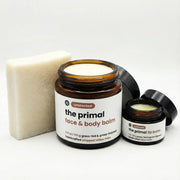
What's in The Primal tallow balm
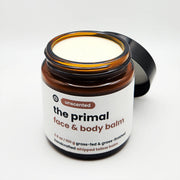
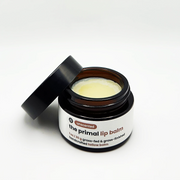
Full disclosure: we make this one, so take the next bit for what it is — but the ingredient list speaks for itself. Our balm runs on a simple idea: raw like nature, real like you. Every ingredient has a job, and nothing is in there just to sound pretty. There's no water, no preservatives, and no synthetics. The full list:
- 100% grass-fed, grass-finished beef tallow
- Cold-pressed organic olive oil
- Organic jojoba oil
- Natural lavender essential oil
- Natural cedarwood essential oil
- Natural lemongrass essential oil
- Natural frankincense essential oil
The tallow is sourced from grass-fed, grass-finished cattle raised on farms in Alberta, Canada, then rendered low and slow to keep its naturally occurring vitamins A, D, E, and K intact. The olive and jojoba oils help it spread easily and leave skin feeling soft, and the essential oils add a soft, natural scent (or skip them entirely with our unscented option).
If you'd rather not decode another label, our unscented whipped tallow balm is about as short an ingredient list as it gets, and you can see the whole range on our tallow balms collection.
"Clean and absorbs so well — skin feels amazing!" — Janelle T., verified review (unscented whipped tallow balm)
"I love the lack of chemicals I can't pronounce." — Jennifer J., verified review
That second one is basically the whole point of this article. A clean balm is one you can read.
The bottom line
Tallow balm, made with care and clean ingredients, is one of the simplest skin-loving things you can put in your routine. The trick is reading past the front-of-jar buzzwords: look for tallow listed first, a short and fully named ingredient list, and no hidden "fragrance." If you want to go deeper, here's the benefits of tallow for skin, real before-and-after results with photos, and if you like a DIY project, our tallow balm recipe with photos. Learning how to store tallow balm will help any jar, homemade or ours, last as long as possible.
Patch-test any new balm first. Skincare is personal and results vary.


